Huaguo Mountain (花果山) — The Monkey King's Legendary Home
Rising from the coastal plains of eastern China, Huaguo Mountain is where myth meets reality. This is the actual mountain described in Journey to the West, where Sun Wukong was born from a stone egg and later crowned himself king of all monkeys. Today, it's one of Jiangsu Province's most captivating destinations.
Hours
7:00 AM – 5:30 PM (peak season: 6:30 AM – 6:00 PM)
Entrance Fee
¥100 (Mar–Nov peak season) / ¥60 (Dec–Feb off season). Cable car: ¥50 one-way.
Getting There
Bus #10 from Lianyungang city center (30 min) or taxi/DiDi (~¥40 from downtown).
Time Needed
4–6 hours for main route. Full day if hiking all peaks and visiting every temple.
Best Season
March–May (spring blossoms) & September–November (clear skies, autumn colors).
About Huaguo Mountain
Huaguo Mountain (literally "Flower-Fruit Mountain") isn't just a beautiful natural landscape — it's one of the most important literary locations in Chinese culture. The 16th-century novel Journey to the West(西游记) by Wu Cheng'en describes this very mountain as the birthplace of Sun Wukong, the Monkey King, who would go on to become one of the most beloved characters in world literature.
The mountain itself is a granite massif rising dramatically from the surrounding coastal plain. Its 136 named peaks, network of caves, ancient temples, and lush vegetation create a landscape that genuinely feels mythical — especially when morning mist rolls through the valleys and macaque monkeys appear along the stone pathways.
Located just outside Lianyungang city center, Huaguo Mountain is easily accessible and has been developed for tourism with well-maintained stone steps, cable cars, and visitor facilities — but it still retains an authentic, spiritual atmosphere that makes it special.
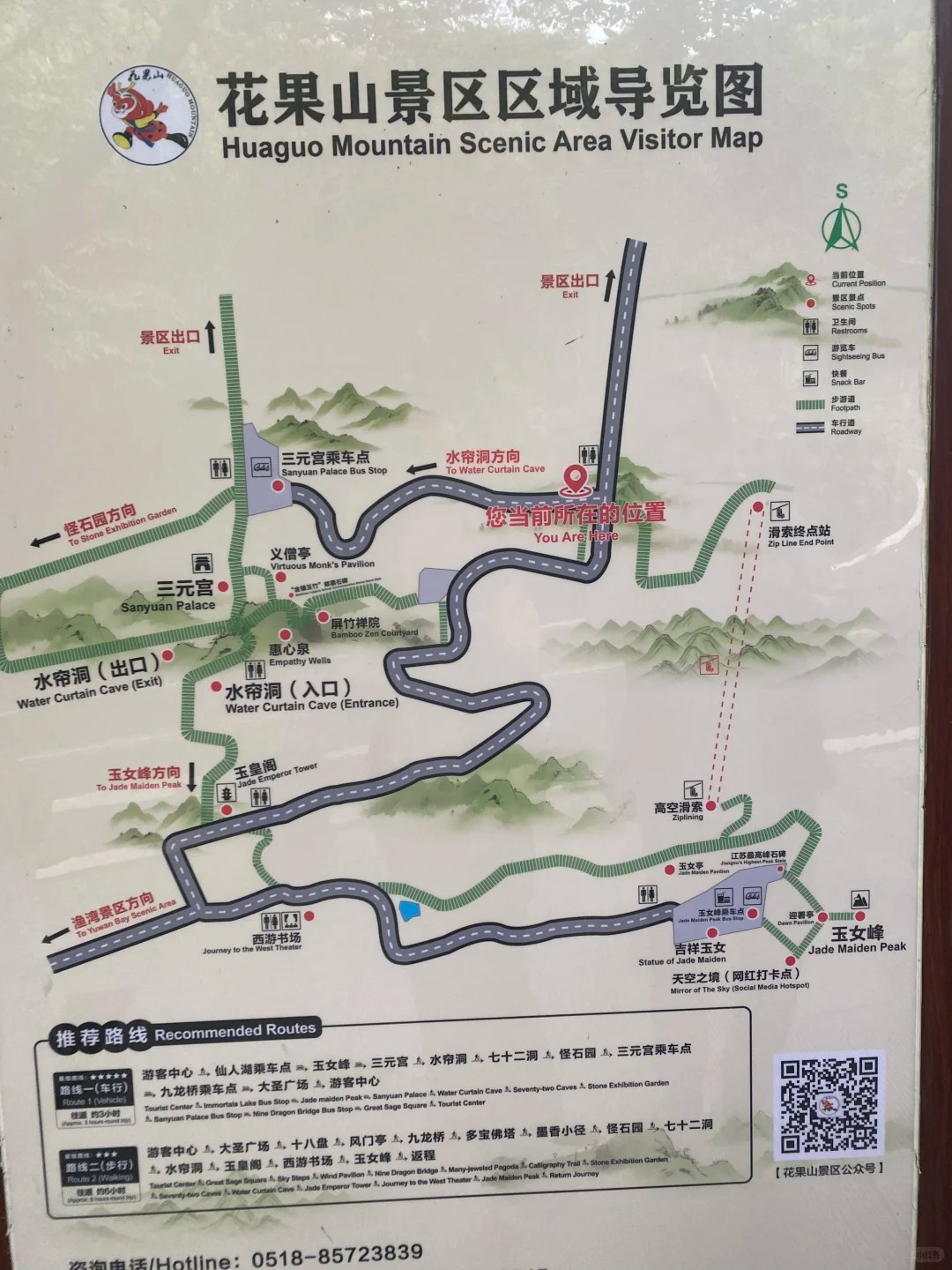
Trail map of Huaguo Mountain scenic area
Must-See Highlights
These are the places you absolutely shouldn't miss. I can arrange the perfect route to see them all.
Water Curtain Cave (水帘洞)
The most iconic site on the mountain. A natural waterfall cascades over the cave entrance — inside, you'll find stone carvings depicting Sun Wukong and his monkey army. According to legend, this is where the Monkey King was crowned. Walk through the falling water (bring a raincoat or buy one at the entrance!) and explore the cave chambers inside.
Jade Girl Peak (玉女峰)
The highest point of Huaguo Mountain at 624 meters. On clear days, you can see the Yellow Sea in the distance. The peak is named after the Jade Maiden from Chinese mythology. A stunning spot for sunrise photography — I can arrange early morning access for serious photographers.
Sanyuan Temple (三元宫)
A beautiful Buddhist temple complex dating back to the Tang Dynasty (618–907 AD). The temple honors three officials of Heaven, Earth, and Water. The architecture is classic Chinese style with intricate roof details, incense-filled courtyards, and monks still practicing daily rituals.
Seventy-Two Caves (七十二洞)
A network of natural caves and rock formations scattered across the mountain. Each cave has its own legend and character. Some are easy to explore, while others require climbing through narrow passages. Great for adventurous travelers and photographers.
Monkey Kingdom
Huaguo Mountain is home to hundreds of wild macaque monkeys — descendants of the Monkey King's legendary army! They're friendly but cheeky. Watch your belongings (especially food and shiny objects). The best spot to see them is near the Water Curtain Cave area in the early morning.
Nine-Dragon Bridge (九龙桥)
A picturesque stone bridge spanning a clear mountain stream. Named for the nine dragon carvings adorning its sides. One of the best photo spots on the mountain, especially in autumn when the surrounding trees turn gold and red.
Visitor Tips & Insider Advice
Start Early
Arrive when the gates open (7 AM). You'll have the mountain almost to yourself for the first hour, and the morning light is magical for photos. By 10 AM, tour buses start arriving and the main paths get busy.
Take the Cable Car Up, Walk Down
The best strategy: take the cable car to Jade Girl Peak (top), then walk down through the temples and caves. This saves your knees and ensures you see everything. The downhill route takes about 3 hours at a relaxed pace with stops.
Monkey Safety
The macaques are used to humans but they're wild animals. Don't carry plastic bags visibly (they associate them with food), don't make direct eye contact, and never try to touch or feed them by hand. Keep your phone and camera secured when monkeys are nearby.
Eat Like a Local
There are snack vendors on the mountain, but the real food experience is in Lianyungang city. Don't miss the fresh seafood (the city is a major fishing port), especially the local specialty: braised sea cucumber with scallions. I can recommend the best local restaurants.
Exploring Lianyungang City
Lianyungang (连云港) is one of China's most underrated coastal cities. As one of the original 14 coastal cities opened to foreign trade, it has a cosmopolitan history alongside its natural beauty. The city's name literally means "Cloud Port" — inspired by the misty harbor views between the mountains and the Yellow Sea.
Beyond Huaguo Mountain, Lianyungang offers sandy beaches at Liandao Island (连岛), natural hot springs, fresh seafood markets where you pick your dinner straight from the tank, and the historic Donghai Temple. The pace of life here is refreshingly slow compared to China's megacities.
Don't miss: the local seafood — Lianyungang is a major fishing port. The braised sea cucumber (葱烧海参) and steamed yellow croaker are local specialties I always recommend to visiting friends.
Getting Around
Buses are frequent and cheap (¥1–2 per ride). DiDi (China's Uber) works well for getting around the city. The high-speed train station connects to Shanghai (~2.5h), Nanjing (~2h), and Beijing (~4h). Lianyungang Huaguoshan Airport has domestic flights to major Chinese cities.
Where to Stay
Most visitors stay downtown near the railway station or in the Xinpu district. There are hotels for every budget — from the five-star Marriott to cozy local guesthouses. I can recommend the best options based on your preferences and arrange everything for you.
Frequently Asked Questions
How difficult is the hike up Huaguo Mountain?▼
There are well-maintained stone steps all the way up, making it accessible for most fitness levels. You can also take the cable car to the top and walk down. The full loop is about 8km with 600m elevation gain. Comfortable walking shoes are essential.
Can I visit Huaguo Mountain on a day trip?▼
Yes! A day trip from Lianyungang city is the most common way to visit. Start early (7–8 AM) to avoid crowds and have time to see everything. If you're coming from Shanghai, you can take an early high-speed train and arrive by 10 AM, explore for 5–6 hours, then return in the evening.
Are there English signs and guides available?▼
Some major signs have English translations, but many smaller ones are Chinese-only. I provide English-speaking guide services to help you navigate and understand the stories behind each location. Having a guide makes the experience much richer.
What should I bring for the visit?▼
Comfortable walking shoes, water, snacks, sunscreen, a rain jacket (for the Water Curtain Cave), and cash (some small vendors don't accept mobile payments from foreign cards). A power bank for your phone is recommended for photos.
Want a Local Guide for Huaguo Mountain?
I'll take you to hidden spots most tourists never see, tell you the real stories behind the legends, and make sure you have an unforgettable experience.
Book a Private Guide